
Field Trip Leaders: Massimiliano Ghinassi1, Andrea Brogi2, Enrico Capezzuoli3, Roberto Tinterri4
1Università di Padova.
2Università di Bari.
3Università di Firenze.
4Università di Parma.
Date: 12-14 September 2026
Cost: € 470 (SGI/SIMP members) - € 800 (non-members and Societies associated with SGI)
Additional costs are expected for single room accommodation (not guaranteed – to be paid on-site).
Minimum number of participants: 20
Maximum number of participants: 40
Description
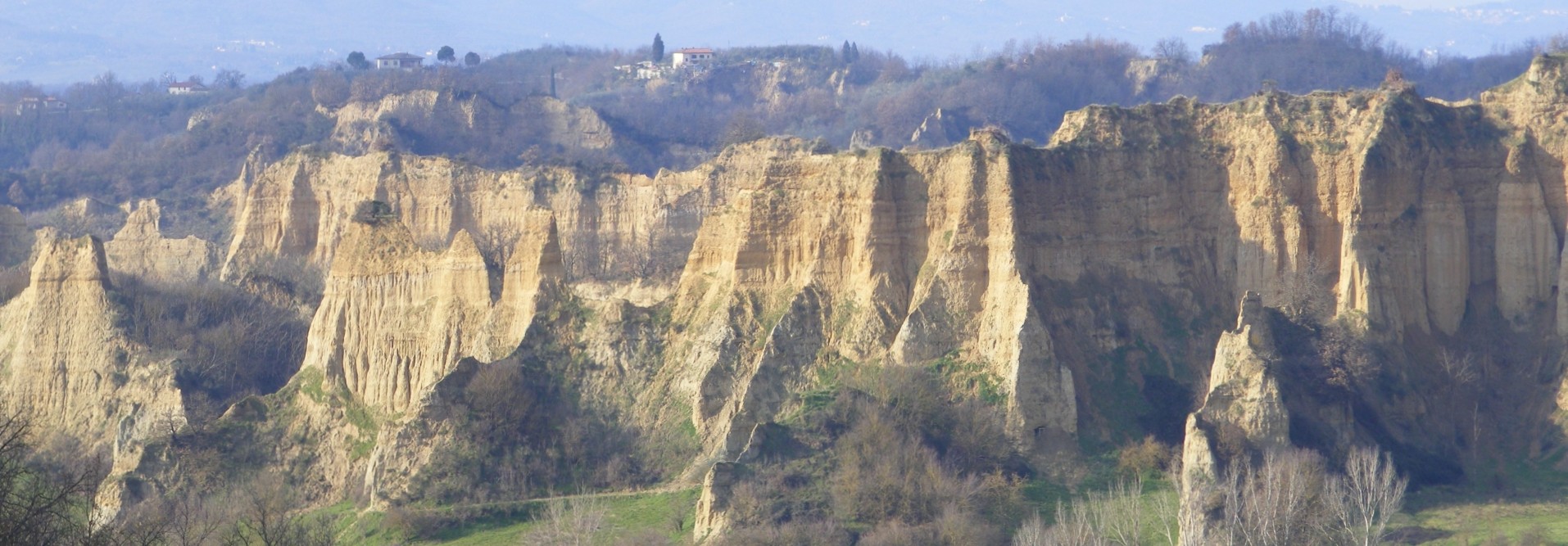
This excursion will take participants on a journey through the geological evolution of the Northern Apennines, moving from the outer zone of the thrust belt to its innermost sectors, where a previously overthickened continental crust was thinned and intruded by granitoids. Along the way, we will observe a wide range of key geological features, from tectono-sedimentary interactions in the foredeep domain, with particular emphasis to the control of basin morphology on facies and processes, to structures that favored lithosphere thinning, magmatic bodies emplacement, and geothermal fluids circulation responsible of travertine deposition and the well-known ore-bodies of the Colline Metallifere district. We will walk on a magmatic body and its metamorphic aureole as well as a mineralized fault exploited since the Etruscan period. Within this framework, we will visit several iconic sites of Italian geology, including classic outcrops that played a major role in the understanding of turbiditic sedimentation, spectacular landscapes shaped by erosion of alluvial-fan deposits in the Valdarno Basin (recognized as a Global Geosite by the International Union of Geological Sciences, UNESCO) and one of the first mineralized deposits described by Bernardino Lotti in 1910 and an exhumed monzogranite with its hosting rocks.
The main topics addressed during the excursion will include:
i) foredeep turbidites of the Marnoso-Arenacea Formation: turbidite deposits in relation to the progressive closure of the foredeep culminating in the deposition of primary evaporites;
ii) tectonics and sedimentation in turbidite systems; relationship between facies, processes, basin confinement and basin morphology;
iii) development of fault-generated alluvial-fan systems;
iv) genesis and evolution of fissure ridge-type travertine depositional system and associated deposits;
v) crustal-scale normal faults mineralized with pyrite and polymetallic sulphides;
vi) an exhumed Pliocene monzogranite and its contact metamorphic aureola, which triggered a geothermal system responsible for Fe-ore deposition (exploited in the Gavorrano mine).
Programme
Day 1: Padova (departure at 7:30 am from the Department of Geosciences, Via G. Gradenigo 6) – Santerno Valley (overview of the Tortonian Marnoso-Arenacea Formation deposits recording the closure of the outer foredeep; facies and processes of tectonically controlled conduits: the Fontanelice channels; syn-sedimentary uplift of the M. Castellaccio thrust: the closure of the Marnoso-Arenacea Formation inner basin; basinal turbidites of the Marnoso-Arenacea Formation inner basin: the Coniale outcrop) – Montevarchi (arrival at hotel at approximately 7:30 PM).
Day 2: Montevarchi – Castelfranco di Sopra (overview of the Pliocene-Pleistocene Upper Valdarno Basin; fault-sourced Pleistocene alluvial fan deposits) – Rapolano Terme (travertine fissure ridge of San Giovanni; travertine quarries) – Massa Marittima (arrival at hotel at approximately 6:00 PM).
Day 3: Massa Marittima – Boccheggiano (mineralization along the Faglia di Boccheggiano) – Gavorrano (monzogranit, low-angle and high angle faults which favored the exhumation, metamorphic aureole) – Padova (arrival at approximately 6:30 PM).
Further information
No stop on the itinerary involves long or particularly demanding walks, but participants should be in reasonably good physical condition. Proper gear is required, including sturdy boots, a waterproof jacket in case of bad weather, warm and wind-resistant clothing, and sun protection (sunscreen and hat). Weather conditions may vary from warm to hot. A packed lunch will be provided on the second and third days, with a small amount of water included. Participants should bring additional water as needed. All accommodation costs, along with breakfast and dinner at the hotels, as well as transportation by bus, are covered by the organization.
Field trip contact: massimiliano.ghinassi@unipd.it